
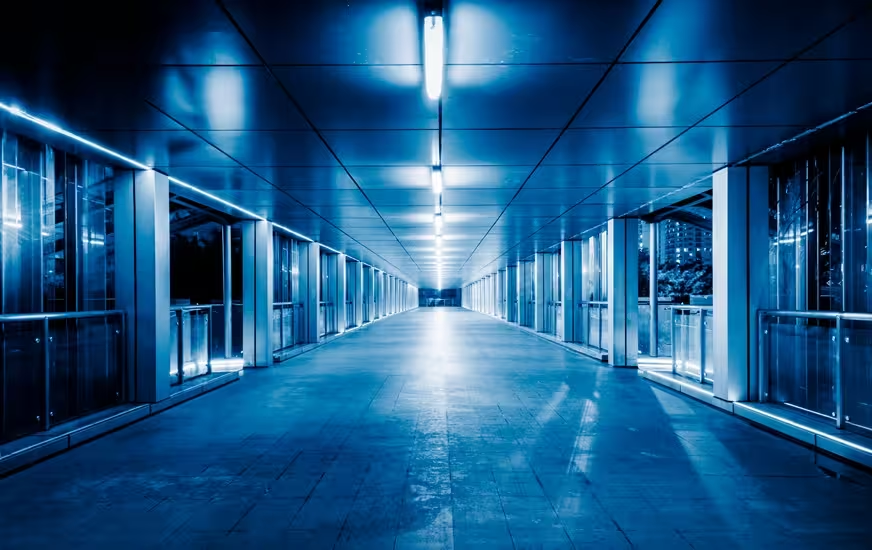
Indoor & Outdoor Lighting Systems
Perfect Solution Contracting provides integrated lighting solutions for commercial buildings, residential developments, industrial facilities, infrastructure projects, hospitality facilities, offices, public spaces, data centers, and other applications requiring reliable and coordinated indoor and outdoor lighting systems.
Our scope can include engineering coordination, technical and material submittals, supply of lighting fixtures and associated accessories, installation, wiring and termination, coordination with lighting controls, inspection, testing, commissioning, and final handover according to approved project requirements.
Lighting systems are selected and coordinated according to the architectural and electrical design, required illumination levels, space function, luminaire type, mounting arrangement, environmental conditions, energy requirements, maintainability, and the approved project specifications.
Modern lighting installations commonly utilize LED luminaires due to their efficiency, controllability, and wide range of optical and architectural options. Luminaire selection should nevertheless be based on the specific performance requirements of each space rather than on light-source technology alone.
Indoor lighting solutions can include recessed, surface-mounted, suspended, linear, downlight, spotlight, track-mounted, decorative, wall-mounted, and other luminaire types according to the architectural concept and approved lighting layout.
Applications can include offices, corridors, reception areas, meeting rooms, technical rooms, plantrooms, electrical rooms, parking areas, warehouses, service areas, and other internal spaces according to project requirements.
Outdoor lighting can include façade lighting, landscape lighting, pathway lighting, parking-area lighting, roadway and access lighting, wall-mounted luminaires, floodlights, bollards, poles, and other exterior luminaires specified by the approved design.
Exterior luminaires are selected according to their installation environment and exposure conditions. Enclosure protection (IP Rating) and, where relevant, mechanical impact resistance (IK Rating) are coordinated with the project specification and installation location.
Lighting performance is not determined only by the electrical wattage of a fixture. Important parameters can include luminous flux, luminaire distribution, beam angle, mounting height, spacing, surface reflectance, room geometry, and the required illumination at the working plane or target surface.
Photometric coordination can be used to verify the lighting arrangement against the design criteria, including required illuminance (Lux), uniformity, luminaire spacing, and other project requirements where applicable.
Color temperature (CCT) is selected according to the intended visual environment and architectural requirements. Different applications may require warm, neutral, or cooler lighting appearances depending on the approved design.
Color Rendering Index (CRI) is also considered where accurate or consistent color appearance is important. The required CRI should be selected according to the application and project specification.
Glare should be considered particularly in offices, workspaces, circulation areas, and other locations where visual comfort is important. Luminaire optics, mounting position, shielding, beam distribution, and layout all contribute to glare performance.
LED luminaires typically incorporate electronic drivers that should be compatible with the luminaire, supply characteristics, environmental conditions, and required control method. Driver accessibility and maintainability should also be considered during installation coordination.
Where dimming is required, luminaires and drivers are selected to support the specified control method. Interfaces can include switched operation, 0–10V, DALI, or other approved technologies depending on the lighting control design.
The detailed automation logic, occupancy control, scheduling, scene control, daylight response, and centralized lighting management are coordinated with the dedicated Lighting Control System where these functions are included in the project.
Lighting circuits are coordinated with the relevant lighting distribution boards, protective devices, circuit schedules, cable sizes, containment systems, switching arrangements, and control interfaces according to the approved electrical design.
Circuit loading should consider the connected lighting load, driver characteristics, switching requirements, conductor capacity, voltage drop, protective devices, and other applicable electrical design factors.
Installation can include the required wiring, conduits, cable containment interfaces, junction boxes, supports, mounting accessories, flexible connections, terminations, and other components necessary for a complete lighting installation according to the approved scope.
Luminaire mounting should be coordinated with ceilings, architectural finishes, structural elements, HVAC diffusers, sprinklers, detectors, speakers, access panels, and other building services to maintain the approved reflected ceiling and coordination layouts.
For suspended or ceiling-mounted luminaires, the installation method and support arrangement should be appropriate for the luminaire type, weight, ceiling system, and approved project requirements.
Emergency lighting can be provided where specified as part of the project's life-safety lighting strategy. Depending on the approved design, emergency luminaires may use self-contained batteries or receive emergency power from a Central Battery System (CBS) or another approved emergency power arrangement.
Exit signs and emergency lighting should be coordinated with the approved life-safety design, required emergency operating duration, escape routes, and applicable project requirements.
Where lighting fixtures are connected to emergency, generator-backed, UPS-backed, or other essential power circuits, the supply arrangement is coordinated with the approved electrical distribution and emergency power philosophy.
Architectural and decorative lighting requires close coordination between the electrical, architectural, interior design, and other relevant teams to achieve the intended mounting positions, visual effect, accessibility, and control requirements.
Façade and landscape lighting can require additional coordination for weather exposure, mounting details, cable routing, waterproof connections, driver locations, maintenance access, and aiming of luminaires.
Lighting poles and associated outdoor installations are coordinated with foundations, cable routes, earthing, access points, pole dimensions, luminaire mounting arrangements, and other project-specific requirements.
Each luminaire type should correspond with the approved lighting fixture schedule, drawings, technical submittals, and identification system. Fixture references should be maintained during procurement, installation, inspection, and handover.
Before procurement and installation, technical documentation can include luminaire data sheets, lighting fixture schedules, shop drawings, reflected ceiling plans, lighting layouts, photometric information, driver data, and control requirements for review and approval.
Inspection of installed lighting can include verification of luminaire type, location, mounting, alignment, circuit identification, wiring, terminations, earthing where applicable, switching, dimming, emergency operation, and other specified functions.
Functional testing is carried out according to the approved testing procedure to verify operation of the luminaires, switching devices, control interfaces, dimming functions, emergency lighting functions, and other applicable requirements before final handover.
Where lighting-control interfaces are included, testing should also verify the required communication and control functions between luminaires, drivers, sensors, controllers, switches, and the associated lighting control system.
Perfect Solution Contracting provides complete indoor and outdoor lighting solutions covering engineering coordination, technical and material submittals, procurement, installation, electrical connections, lighting-control coordination, inspection, testing, commissioning, and final handover according to project requirements.
- Indoor lighting systems.
- Outdoor lighting systems.
- LED luminaires and associated drivers.
- Recessed and surface-mounted luminaires.
- Suspended and linear lighting.
- Downlights, spotlights, and track lighting.
- Architectural and decorative lighting.
- Façade and landscape lighting.
- Parking and external-area lighting.
- Floodlights, bollards, and lighting poles.
- Emergency lighting and exit signs.
- Central Battery System (CBS) interfaces where specified.
- IP and IK rating coordination.
- Color temperature (CCT) coordination.
- Color Rendering Index (CRI) requirements.
- Illuminance and photometric coordination.
- Glare and visual-comfort considerations.
- LED drivers and dimming interfaces.
- DALI / 0–10V interfaces where specified.
- Lighting circuit wiring and terminations.
- Ceiling and MEP coordination.
- Fixture schedules and technical submittals.
- Lighting control system coordination.
- Inspection and functional testing.
- Testing, commissioning, and final handover.