
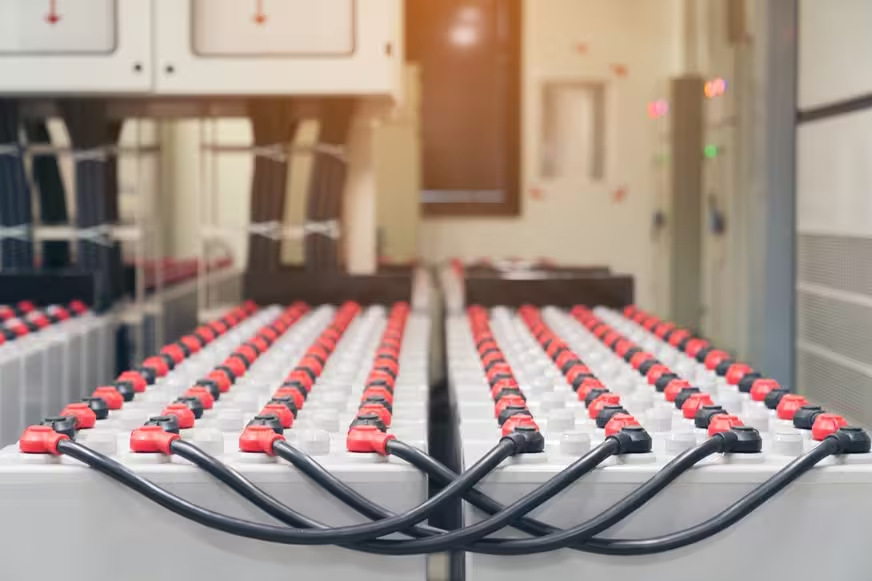
Central Battery System (CBS)
Perfect Solution Contracting provides integrated Central Battery System (CBS) solutions for emergency lighting and exit-sign applications in commercial buildings, industrial facilities, infrastructure projects, public buildings, data centers, and other facilities requiring centralized emergency-lighting power.
A Central Battery System provides a centralized source of stored electrical energy for designated emergency luminaires and exit signs when the normal electrical supply is unavailable or when the emergency-lighting system is required to operate.
The system can combine batteries, charging equipment, control units, emergency-lighting distribution circuits, monitoring interfaces, automatic testing functions, and compatible emergency luminaires within an integrated emergency-lighting architecture.
Our scope can include engineering coordination, technical submittals, equipment supply, installation, batteries, power and control cabling, emergency luminaires, exit signs, monitoring interfaces, testing, commissioning, training, and final handover according to the approved project requirements.
Central Battery System Operation
During normal operating conditions, the Central Battery System maintains the batteries at the required state of charge while monitoring the available power supply and relevant system conditions.
When the normal electrical supply fails or another defined emergency condition occurs, the system supplies the designated emergency-lighting circuits from the stored battery energy according to the approved operating philosophy.
The exact operating sequence depends on the selected system architecture, emergency-lighting design, circuit configuration, and project requirements.
CBS vs. UPS Systems
A Central Battery System for emergency lighting should be distinguished from a general Uninterruptible Power Supply (UPS) system.
In this application, the CBS is primarily intended to supply and monitor designated emergency luminaires and exit signs, while a UPS is generally used to provide uninterrupted electrical power to critical electrical or electronic loads according to the facility design.
Central Battery Units
The central battery unit integrates the main components required to charge, control, monitor, and distribute emergency power to the connected emergency-lighting circuits.
System capacity is selected according to the total connected emergency-lighting load, required autonomy, distribution arrangement, operating voltage, battery characteristics, future capacity where specified, and the approved system design.
Battery System
The batteries provide the stored energy required to operate the connected emergency-lighting loads during loss of the normal electrical supply.
Battery capacity is determined according to the connected load, required operating duration, system voltage, discharge characteristics, environmental conditions, battery technology, and manufacturer requirements.
Battery aging, temperature, discharge rate, and applicable design margins can affect the required installed capacity and should be considered during system design.
Battery Charger & Control Equipment
The system incorporates suitable charging and control equipment to maintain the batteries and manage the emergency-lighting power supply according to the architecture of the selected Central Battery System.
Depending on the selected product, the controller can monitor battery condition, charger status, incoming supply, outgoing circuits, alarms, emergency luminaires, and other supported operating parameters.
Emergency Luminaires
Emergency luminaires are coordinated with the approved emergency-lighting design, escape routes, exits, stairways, corridors, and other locations requiring emergency illumination.
Depending on the selected system, dedicated emergency luminaires or compatible luminaires incorporated into the normal lighting arrangement can be connected to the Central Battery System.
Luminaire type, output, operating mode, monitoring capability, and compatibility with the CBS are verified through the approved technical documentation.
Exit Signs
Exit signs can be connected to the Central Battery System where included in the approved emergency-lighting design.
Their locations and operating requirements are coordinated with the approved escape routes, emergency exits, corridors, stairways, and life-safety design.
Maintained & Non-Maintained Operation
Emergency luminaires can operate in different modes according to the system design.
Maintained emergency lighting remains illuminated during normal conditions and continues operating from the emergency source when required.
Non-Maintained emergency lighting normally operates when the normal lighting supply fails or when the defined emergency operating condition occurs.
The required operating mode is determined for each luminaire or circuit according to the approved emergency-lighting philosophy.
Battery Autonomy
Required battery autonomy is determined by the project requirements and approved emergency-lighting design rather than assuming one fixed duration for every installation.
Actual available runtime depends on the connected load, battery capacity, battery condition, temperature, discharge characteristics, system efficiency, and operating conditions.
Battery sizing calculations are used to verify that the selected battery arrangement can support the designated emergency loads for the required operating period under the specified design conditions.
Emergency Lighting Distribution Circuits
Emergency-lighting loads are distributed across suitable outgoing circuits according to building layout, connected load, system architecture, and the approved emergency-lighting design.
Circuit quantities, ratings, protective devices, cable sizes, and routing are coordinated with the Central Battery System and approved electrical drawings.
Addressable Monitoring
Where supported by the selected system, addressable modules can be used to identify and monitor individual emergency luminaires or groups of devices.
Addressable monitoring can assist facility operators in identifying equipment status and locating reported faults through the central monitoring platform.
The addressing method and associated modules depend on the manufacturer and system architecture and should therefore be selected as part of the approved CBS solution.
Luminaire Monitoring
Compatible emergency luminaires can incorporate monitoring components that allow the Central Battery System to supervise their operating status and perform supported test functions.
Monitoring technology varies between manufacturers and system architectures. A specific light-sensing module or address module should therefore not be assumed to be mandatory for every Central Battery System.
Central Monitoring System
The CBS can include a centralized monitoring platform for supervising batteries, chargers, outgoing circuits, emergency luminaires, alarms, faults, and test results where these functions are supported by the selected system.
Monitoring equipment can be located in the control room or another approved location and connected to the Central Battery System through the required communication interfaces.
Monitoring Software
Where software-based monitoring is included, the system can provide a graphical or structured interface for reviewing system status, alarms, emergency luminaires, circuits, batteries, and test information.
Depending on the selected platform, functions can include event logging, fault reporting, test records, equipment identification, and historical system information.
Automatic Testing
Central Battery Systems can provide automatic testing functions for emergency luminaires, circuits, batteries, and other monitored components where supported by the selected system.
Automatic testing can include functional tests and duration tests according to the system capability, approved testing schedule, and project requirements.
Test intervals and operating sequences are configured according to the selected equipment, approved procedures, and facility maintenance requirements.
Functional Tests
Functional testing verifies that the designated emergency luminaires and exit signs operate as intended when the applicable emergency condition is simulated.
Testing can also verify alarms, monitored circuits, luminaire status, charger operation, and other functions included within the approved system.
Duration Testing
Where required, a duration test can be performed to verify the ability of the battery system to support the designated emergency-lighting load for the specified period.
Test duration, load conditions, starting battery condition, operating conditions, and acceptance criteria are defined by the approved commissioning procedure and project requirements.
Fault & Alarm Monitoring
Depending on the selected system, monitoring can include loss of normal supply, charger faults, battery conditions, outgoing-circuit faults, luminaire faults, communication faults, and other supported system alarms.
Alarm information can be displayed locally, through the central monitoring platform, or transferred to another building monitoring system where the required interface is provided.
BMS Integration
Where specified, the Central Battery System can interface with the Building Management System (BMS) for monitoring selected operating conditions and alarms.
Integration can include general system status, common alarm, battery condition, charger status, or other supported points according to the approved points list and communication architecture.
Emergency Lighting Cables
Cable selection for Central Battery System circuits considers system voltage, connected current, route length, installation method, voltage drop, protective-device requirements, and the approved emergency-lighting design.
Cable construction and performance requirements are selected according to the applicable circuit, project fire-safety requirements, installation environment, and approved specifications.
Voltage Drop
Voltage drop is an important consideration, particularly where emergency-lighting circuits are long or where the Central Battery System uses a lower distribution voltage.
Cable sizes, circuit lengths, connected loads, and system operating characteristics are coordinated to maintain suitable voltage at the connected emergency luminaires.
Circuit Protection
Appropriate protection is provided for outgoing circuits according to system voltage, load current, fault conditions, CBS characteristics, and the approved distribution design.
Protective devices are coordinated with the selected Central Battery System and manufacturer requirements to support the required system operation.
Earthing & Bonding
Central Battery System panels, cabinets, racks, and associated metallic equipment are bonded to the facility earthing system according to the approved electrical design.
Earthing and bonding arrangements are coordinated with the system architecture, equipment requirements, operating voltage, and project grounding philosophy.
Battery & Equipment Room Coordination
Central battery equipment is coordinated with the available installation area, maintenance clearances, access requirements, environmental conditions, ventilation, and temperature requirements of the selected equipment.
Battery and cabinet weights, floor loading, equipment transportation routes, maintenance access, and future battery replacement should also be coordinated with the architectural, structural, and mechanical design.
Emergency Lighting Design Coordination
The Central Battery System is coordinated with the approved emergency-lighting layout, escape routes, exits, stairways, corridors, and other designated areas requiring emergency illumination.
The presence of a Central Battery System does not by itself determine the required quantity or location of emergency luminaires. These are defined by the approved emergency-lighting and life-safety design.
Technical Submittals
Technical submittals can include Central Battery System data sheets, system capacity, operating voltage, battery type and capacity, autonomy calculations, charger information, outgoing circuits, monitoring functions, addressable interfaces, and communication capabilities.
Submittals can also include emergency-luminaire and exit-sign data where these components form part of the approved supply scope.
Shop Drawings
Shop drawings can identify the Central Battery System location, battery arrangement, distribution circuits, cable routes, emergency luminaires, exit signs, monitoring devices, and interfaces with other systems.
The drawings are coordinated with electrical, architectural, mechanical, structural, and life-safety requirements before installation.
Battery Sizing Calculations
Battery sizing calculations are prepared or reviewed according to the actual connected emergency-lighting load, required autonomy, system characteristics, battery performance, and approved design criteria.
Calculations should be based on the approved technical data for the selected system, batteries, and luminaires rather than applying a generic battery capacity to every project.
Pre-Commissioning
Following installation, the Central Battery System, batteries, outgoing circuits, emergency luminaires, monitoring components, communication interfaces, and earthing arrangements are inspected before functional commissioning.
Pre-commissioning can include verification of connections, polarity where applicable, battery condition, charger operation, system settings, circuit identification, alarms, and communication interfaces.
Testing & Commissioning
Commissioning verifies the operation of the Central Battery System under normal and emergency conditions according to the approved sequence of operation.
Testing can include simulation of normal-supply failure, emergency-luminaire operation, exit-sign operation, charger and battery status, outgoing circuits, monitoring, addressing, alarms, and communication functions.
Functional and duration testing can be carried out according to the approved commissioning procedure and project requirements.
Handover & Training
Final handover can include approved as-built drawings, test reports, equipment data, battery information, operation and maintenance manuals, system configuration records, and other documents required by the project.
Where included in the project scope, operator training can cover basic system operation, monitoring, alarms, automatic testing, reporting, and routine maintenance requirements.
Warranty Period Maintenance
Where maintenance during the warranty period is included in the contract, scheduled inspections and maintenance activities can be performed according to the agreed scope and manufacturer recommendations.
Maintenance can include checking system status, battery condition, charger operation, alarms, monitored circuits, test records, and other applicable system components.
Standards & Project Requirements
Central Battery Systems and associated emergency lighting equipment are selected, installed, and tested according to the approved project specifications, manufacturer requirements, applicable life-safety requirements, and relevant standards for the selected system and application.
Battery autonomy, monitoring architecture, automatic testing, cable requirements, luminaire operation, and system configuration are determined according to the applicable project requirements rather than assuming one universal arrangement for all Central Battery Systems.
Perfect Solution Contracting provides complete Central Battery System solutions covering engineering coordination, technical submittals, procurement, installation, batteries, chargers, distribution circuits, emergency luminaires, exit signs, monitoring, addressing, system integration, testing, commissioning, and final handover according to the approved project scope.
- Central Battery Systems (CBS).
- Emergency lighting systems.
- Emergency luminaires.
- Exit signs.
- Central battery units.
- Battery banks.
- Battery cabinets and racks.
- Battery chargers.
- Battery sizing calculations.
- Battery autonomy calculations.
- Maintained emergency lighting.
- Non-Maintained emergency lighting.
- Emergency-lighting distribution circuits.
- Addressable monitoring where supported.
- Luminaire monitoring.
- Central monitoring systems.
- Monitoring software.
- Fault and alarm monitoring.
- Automatic testing where supported.
- Functional testing.
- Duration testing.
- Emergency-lighting cabling.
- Voltage-drop calculations.
- Circuit protection.
- Earthing and bonding.
- Battery-room coordination.
- Emergency-lighting design coordination.
- BMS integration where specified.
- Technical and material submittals.
- Shop drawings.
- As-built drawings.
- Pre-commissioning.
- Testing and commissioning.
- Operator training where required.
- Warranty-period maintenance where included.
- Final handover documentation.